What Is Friction, and Why Is It Silently Destroying Your Guest Experience?

There is a word that explains most of the gap between what a short-term rental is capable of delivering and what it actually delivers. That word is friction.
Not the friction of something broken. Not the friction of a complaint that gets filed and addressed and resolved. The other kind. The kind that never generates a complaint because the guest cannot fully articulate it. The kind that is too small in any given moment to mention but too consistent across seven days to ignore. The kind that shows up in a four-star review with no specific feedback, in a positive comment that somehow does not feel positive, in the guest who had a fine stay and books somewhere else next time.
That friction is doing damage every stay. And most hosts have no idea it exists.
Friction Does Not Announce Itself
In the context of guest experience design, friction is any point where the environment resists what the guest is trying to do, feel, or experience. It is the gap between what the space promises and what it delivers at the moment of use. It is the mismatch between what the host intended and what the guest actually encountered.
Friction is not dramatic. It does not present as a crisis. It presents as a moment of slight difficulty, a brief confusion, a small inconvenience, something that required more effort than it should have. Individually, those moments are forgettable. Accumulated across a three-night or seven-night stay, they compose the texture of the entire experience. They are the difference between a guest who leaves feeling restored and a guest who leaves feeling like the stay was mostly fine.
The critical thing to understand about friction is that it almost never shows up clearly in guest feedback. Guests are not friction analysts. They experience friction as a feeling, not a diagnosis. They feel slightly less comfortable than they expected, slightly more effortful than they wanted, slightly less at home than the listing implied. They do not know what caused those feelings. They know how the stay felt, and that feeling becomes the review.
The review says four stars and something like great location, comfortable place, would recommend. The host reads that and thinks the stay went well. The stay went well enough. It did not go as well as the property was capable of making it go.
Why Hosts Cannot See Their Own Friction
The most common reason friction persists in a short-term rental is that the host is not the guest. This sounds obvious but it has a specific and consequential meaning.
When a host walks through their property, they are walking through a space they know. They know where things are. They know how the door handle works. They know the quirk with the shower pressure and the fact that the third drawer in the kitchen sticks a little. They know these things so completely that they have stopped experiencing them as friction. The space is fluent to them. It is a foreign language to the guest arriving for the first time.
This is why self-assessment of friction is so unreliable. The host who designed the space, furnished the space, and manages the space cannot un-know what they know about it. Every time they evaluate it, they are evaluating it with information the guest does not have. They do not encounter the same space. They encounter a version of the space that has been edited by familiarity into something easier than it actually is.
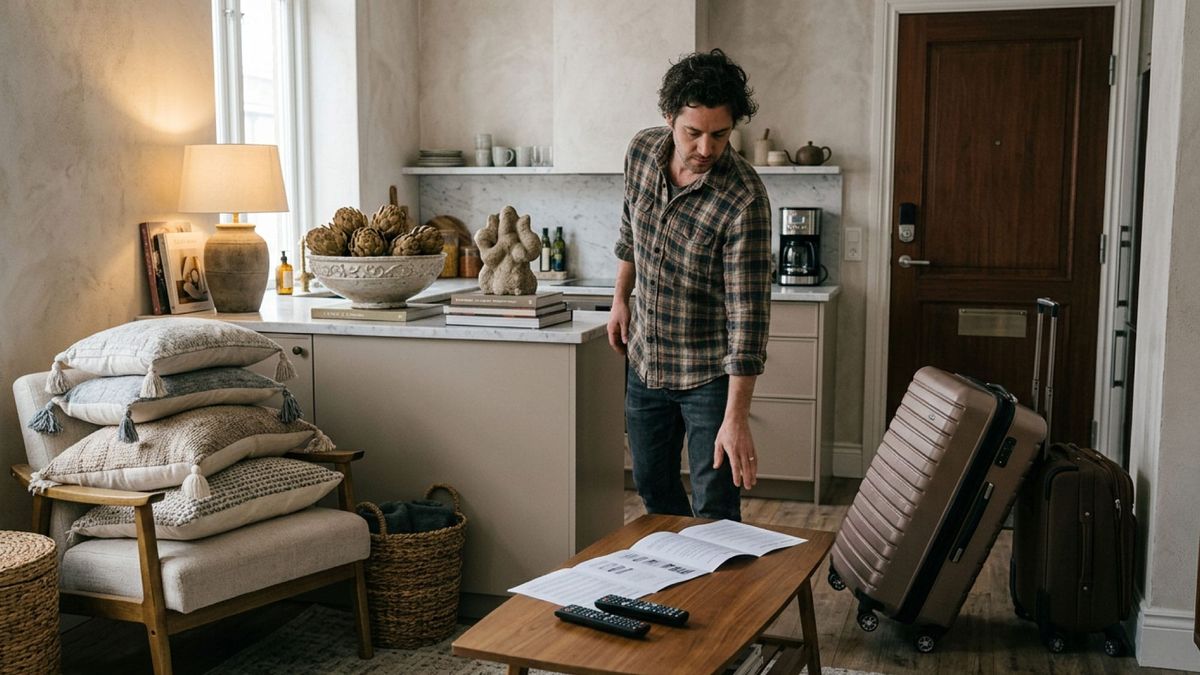
There is a second reason friction is hard for hosts to see: it is distributed. No single element of friction is typically obvious enough to flag on its own. The entry that has nowhere to put bags is a minor inconvenience. The kitchen drawer that sticks is a minor inconvenience. The instruction sheet for the TV that is three pages long and starts with model number references is a minor inconvenience. The outdoor furniture arranged for visual balance rather than conversation is a minor inconvenience. Individually, none of these demand attention. Together, across a stay, they compose an experience that consistently underdelivers and consistently produces reviews the host cannot fully explain.
The Friction Audit exists specifically because hosts cannot reliably identify their own friction. It is a structured methodology for seeing a space the way a guest sees it, evaluating each zone and each element through the lens of what the guest is trying to do rather than what the host intended.
The Four Types of Friction
Guest Behavior Architecture identifies four distinct types of friction, each operating differently and each requiring a different approach to diagnosis and resolution.
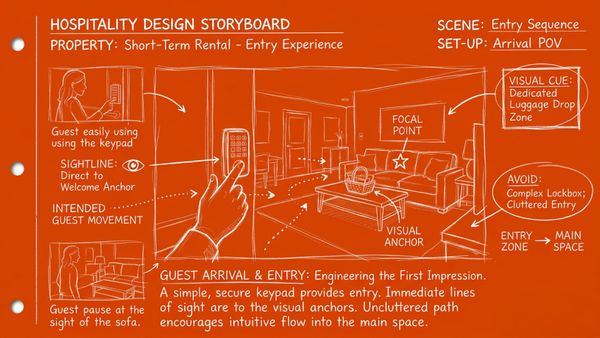
Physical friction is the most observable category. It is friction that exists in the tangible structure and layout of the space. A layout that does not flow logically. Furniture that blocks natural pathways. A configuration that requires more effort to navigate than it should. Physical friction is the most likely kind to generate a direct complaint, but it is still frequently missed because guests tend to adapt to it rather than confront it, and adaptation obscures the cost.
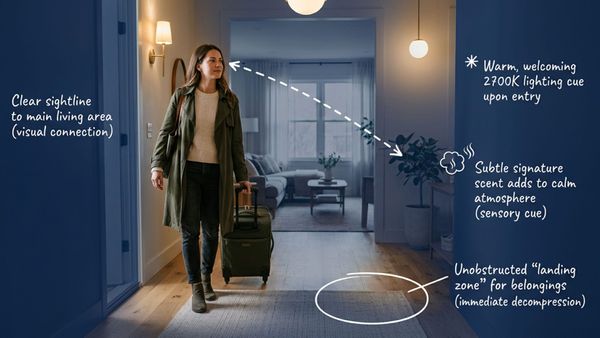
Sensory friction operates through the senses and is almost never articulated in guest feedback. Lighting that is too bright, too dim, or wrong for the time of day produces a feeling the guest cannot name. A scent that is too strong, too chemical, or mismatched with the character of the space produces a discomfort the guest attributes to something else. Temperature inconsistency, acoustic problems, visual clutter that reads as noise rather than design — all of these are sensory friction. They affect how a guest feels in a space without ever being identifiable as the cause.
Informational friction happens at every moment a guest needs to know something and the information is not clearly present. Where do extra towels live? How does the gate code work? What is the process for the garbage? When something is not communicated clearly and in context, the guest has to work for information they should not have to work for. That work is friction. The guest who has to search for basic operational information about a space is a guest who has been taken out of the experience of the stay and put into the experience of managing the property.
Emotional friction is the deepest and most consequential category. It is the friction that results from a mismatch between what the property promised and what the guest actually received. It is not about a specific failure. It is about the cumulative sense that the stay did not deliver on the expectation the listing created. A property that photographs as warm and personal and arrives as cold and generic has created emotional friction. A listing that implies a certain quality of rest and delivers a bedroom that is functional but unconsidered has created emotional friction. This type of friction is the hardest to diagnose because it operates at the level of expectation rather than at the level of specific, observable elements.
How Friction Accumulates
The reason friction is so damaging over the course of a stay is that it compounds. A single moment of friction is recoverable. The guest works through it, finds what they need, adapts to the space, and moves on. Multiple moments of friction across multiple zones across multiple days create a pattern that the guest experiences as the overall character of the stay.
This is why a property with no single obvious problem can still reliably underperform. The problem is not the kitchen drawer that sticks or the pillow arrangement that requires management or the instruction sheet that takes five minutes to decode. The problem is all of those things together, accumulating across the stay into a texture of slight resistance that the guest feels but cannot fully explain.
The host sees a four-star review with no specific complaint and concludes the stay went well. The guest experienced a stay that was consistently slightly harder than it needed to be and gave a rating that reflected that experience without being able to say why.
The Cost of Invisible Friction
Friction has a measurable cost. It shows up in star ratings that plateau just below five. It shows up in guests who do not rebook a property they did not dislike. It shows up in reviews that are positive but not enthusiastic, that recommend the property without selling it, that use words like fine and comfortable and decent rather than words like incredible or exactly what we needed or we are already planning to come back.
The gap between those two sets of words is a revenue gap. A property that consistently generates genuinely enthusiastic reviews commands more nights booked, higher nightly rates, and stronger repeat booking rates than a property that consistently generates politely positive ones. The difference between those two outcomes, compounded across a full booking calendar, is significant. And in most cases, the difference is friction.
Friction is also a compounding problem on the guest relationship side. A guest who experiences a frictionless stay has their expectation of the property confirmed or exceeded. A guest who experiences a friction-heavy stay has their expectation eroded. Eroded expectations do not produce repeat bookings. They produce guests who keep looking for something better because they assume the friction they felt is just part of what short-term rental stays are. It does not have to be. But they have to encounter a frictionless property to know that.
Find It, Name It, Remove It
The GBA commitment to friction is structured around three steps, and the order matters.
Find it first. Friction that has not been identified cannot be addressed. The Friction Audit is the systematic process of moving through a property with the guest's perspective rather than the host's, evaluating each zone against the behaviors it is supposed to produce, and documenting every point where the environment creates resistance. The Friction Map that results from this process is a complete picture of where the experience is breaking down and what it is costing.
Name it second. Naming friction matters because vague awareness does not produce action. Knowing that the kitchen feels hard to use is different from knowing that there is no clear prep surface left of the stove and the decorative bowl on the counter occupies the space where a guest would naturally put a cutting board. The first version produces a general concern. The second version produces a specific and addressable problem. The Friction Audit names everything it finds with enough precision to act on it.
Remove it last. Friction removal is not always renovation. Many of the most significant friction points in a short-term rental are resolved by repositioning furniture, reorganizing storage, improving information delivery, or making targeted changes to the sensory environment. The Design Prescription that follows the Friction Audit translates each named friction point into a specific, buildable recommendation. Some of those recommendations are inexpensive. Some require more investment. All of them are worth more than the friction they replace.
Invisible friction is not an inevitable feature of the short-term rental experience. It is a design problem, and design problems have design solutions. The host who finds it, names it, and removes it has a property that performs the way it was always capable of performing. The host who never looks for it will keep reading four-star reviews and wondering what they are missing.