The GBA Process: Three Steps That Transform How You Design a Stay
Guest Behavior Architecture turns better stays into a repeatable process: define the behavior, audit the friction, and prescribe the fix. Better reviews start with a better system, not better styling.


A framework without a process is a philosophy. Guest Behavior Architecture is not a philosophy. It is a methodology, which means it produces the same quality of output regardless of which property it is applied to, regardless of the size or price point or location of the rental, and regardless of how much or how little the host has thought about guest experience design before. A methodology is repeatable. A philosophy is not.
The GBA process is three steps. The steps are named: Behavior Mapping, the Friction Audit, and the Design Prescription. Each step has a distinct purpose, a distinct output, and a distinct relationship to the steps before and after it. The sequence is not a preference. It is a requirement. Performing the steps out of order produces a degraded result, and skipping any step entirely produces a result that is directionally right but fundamentally incomplete.
This post walks through all three steps in full: what each one does, what it requires, what it produces, and why the sequence holds.
A Methodology Requires Sequence
Before walking through the steps, it is worth explaining why the sequence is non-negotiable, because the temptation to reorder or compress the process is real and almost always wrong.
The most common shortcut hosts take is starting with the Design Prescription. They identify something about their property that seems like it could be better, they research what other properties have done, and they implement a change. Sometimes the change helps. More often it addresses a surface symptom while leaving the underlying friction intact, or it improves one element of the property while creating friction somewhere else, or it solves a problem that was not the most significant one the property had. Design without a prior audit and design without a prior behavioral map is design in the dark. It produces changes, not improvements.
The second most common shortcut is starting with the Friction Audit while skipping Behavior Mapping. This produces a list of friction points without a clear standard for evaluating their significance. Not all friction is equally costly. The friction that disrupts the behavior the Gathering Zone is most responsible for producing is more significant than the friction that creates a momentary inconvenience in a low-traffic area of the property. Without a Behavior Map defining what each zone is supposed to produce, the Friction Audit has no standard to audit against. It finds things that seem wrong without being able to say how wrong or in service of what correction.
Behavior Mapping first. Friction Audit second. Design Prescription third. The sequence is the methodology.
Step One: Behavior Mapping
Behavior Mapping is the process of defining, for each zone of the property, the specific behavioral outcomes the stay requires. It is the step that answers the foundational question of Guest Behavior Architecture before any evaluation of the current property begins: what do I want this guest to do, feel, and experience in this space?
The output of Behavior Mapping is a Behavior Map, a zone-by-zone document that describes the intended behavioral state of the guest in each territory of the property at each stage of the stay. It is not a mood board. It is not a list of amenities. It is a precise description of behavioral intent.
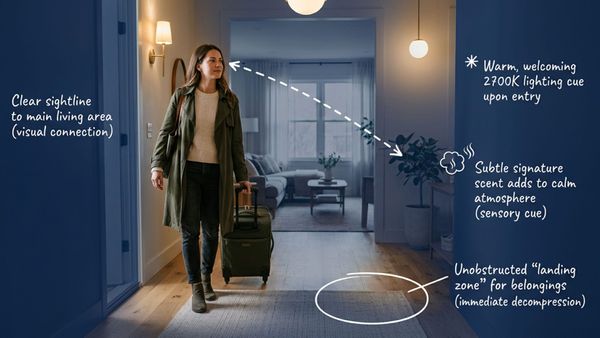
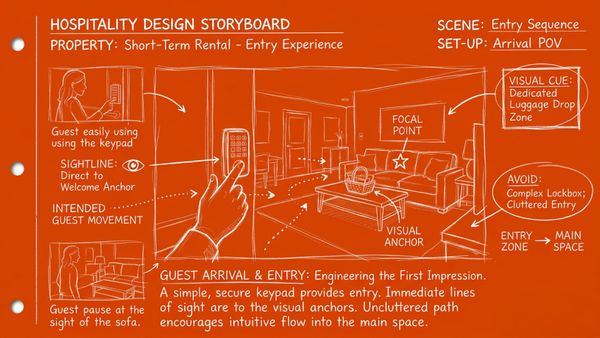
For the Arrival Zone, the Behavior Map defines what a successfully arrived guest looks like. They are oriented. They know where everything is without having to search. Their belongings are settled. The transition from the journey to the stay is complete and they are beginning to decompress. They have received a clear first signal that the property will deliver on what the listing promised. That is the behavioral target. Everything in the Arrival Zone is measured against it.
For the Gathering Zone, the Behavior Map defines what a successfully gathered group looks like. They are in the space together without effort. The layout supports the activities they came to share. The kitchen cooperates with the cooking they planned. The indoor and outdoor environments communicate with each other in a way that makes moving between them natural rather than effortful. The space communicates permission rather than caution and the group inhabits it fully rather than carefully. That is the behavioral target for the Gathering Zone.
For the Restoration Zone, the Behavior Map defines what genuine rest looks like in this specific property. The guest enters the bedroom and the environment is already working in their favor. Light control is adequate for the sleep they need. Sound management is sufficient for the quiet they came for. The bed is set up for the way people actually sleep rather than the way beds are styled for photography. The bathroom is organized so that a guest moving through it in the dark encounters no resistance. The guest wakes up restored rather than merely rested, and that distinction matters.
For the Experience Zone, the Behavior Map defines the complete delivery of what the property's distinguishing feature was listed to provide. The guest discovered it. The guest accessed it without friction. The guest used it at the quality the listing implied. The experience produced a memory specific enough to appear in a review. That is the behavioral target for the Experience Zone, and every decision about how the Experience Zone is designed, communicated, and maintained is measured against it.
Behavior Mapping can feel like it is documenting the obvious. Of course the guest should sleep well. Of course the group should be able to gather easily. The value is not in the targets themselves but in the precision with which they are stated, because precision is what makes the subsequent Friction Audit possible. You cannot audit against a vague intention. You can audit against a specific behavioral target.
Step Two: The Friction Audit
The Friction Audit is the evaluation of the property's current state against the behavioral targets defined in the Behavior Map. Its purpose is to find every point where the current environment is producing an outcome other than the one the Behavior Map requires, and to document each point with enough precision to prescribe against it.
The output of the Friction Audit is the Friction Map, the zone-by-zone, friction-typed record of every gap between what the property currently does and what the Behavior Map says it needs to do. Each entry in the Friction Map names a location, a friction type, a behavioral consequence, and the information needed to write a prescription. The Friction Map is the bridge between the diagnostic process and the design response.
The Friction Audit is conducted from the guest's perspective, not the host's. This is the most demanding requirement of the step and the one most often compromised in self-administered attempts. The host must approach the property as a person encountering it for the first time, without the knowledge of where things are, how the quirks work, or which aspects of the space require adaptation that has become so habitual the host no longer notices it. The techniques for achieving this perspective, the staged entry, intent tracing, and review translation, were covered in detail in Post 7 of this series.
The Friction Audit moves through the property zone by zone and evaluates each zone against all four friction types. Physical friction: does the current configuration of this zone resist the behaviors the Behavior Map identified as required? Sensory friction: does the light, scent, sound, or temperature of this zone work against its behavioral purpose? Informational friction: is there any moment in this zone where a guest needs information that is not clearly present at the point of need? Emotional friction: does anything in this zone create a gap between what the listing implied and what the guest actually encounters?
The Friction Audit is exhaustive by design. It does not triage before documenting. Every friction point found is recorded, regardless of its apparent severity, because the severity of friction cannot be fully assessed until the full picture is visible. A friction point that seems minor in isolation may be the final compounding element that tips a stay from enthusiastic to merely positive. Nothing is dismissed during the audit phase. Prioritization happens in the prescription phase.
Step Three: The Design Prescription
The Design Prescription is the actionable output of the GBA process. It takes each friction point documented in the Friction Map and translates it into a specific, buildable change to the property. Not a direction to improve the space generally. A named intervention with a clear target outcome, sequenced by priority and scoped by the investment the change requires.
The Design Prescription is organized in the same zone-by-zone structure as the Friction Map, which makes it navigable and implementable by section. A host who wants to address the Restoration Zone first can read directly to that section of the Prescription and execute against it without needing to hold the full document in mind. A host working with a budget constraint can sort prescriptions by investment level and implement the zero-cost and low-cost changes immediately while planning for the higher-investment ones.
Each entry in the Design Prescription contains three components. The friction point it addresses, carried forward from the Friction Map by location and type. The prescribed intervention, stated with enough specificity to execute: reposition the sectional to face the window rather than the television wall, replace the current curtains with blackout lining on the east-facing window, add a laminated single-page visual guide to the outdoor kitchen mounted at standing eye level at the point of first approach. And the expected behavioral outcome of the intervention: the Gathering Zone will communicate connection rather than passive consumption, the Restoration Zone will support the sleep behaviors the bedroom is responsible for producing, the Experience Zone feature will be discovered and used by guests who would have previously left it underused.
The Design Prescription also identifies the priority of each intervention. Priority is determined not by cost but by behavioral significance. The friction point that is most directly disrupting the behavioral outcome the zone is responsible for producing is the highest priority, regardless of how inexpensive or expensive the fix is. A ten-dollar organizational change that resolves the primary friction point in the Gathering Zone is a higher priority than a five-hundred-dollar furniture piece that addresses a secondary aesthetic issue in the same zone.
The Prescription does not assume renovation. The majority of friction points in most properties are addressable through changes that cost nothing or very little: repositioning, reorganizing, removing, communicating differently. The changes that require real investment are typically in the minority, and the Prescription treats them with the same specificity as the low-cost ones so that when the investment is available the direction is already clear.
What the Process Produces
A property that has been through the full GBA process — Behavior Mapping, Friction Audit, Design Prescription — is a fundamentally different property than one that has been styled, furnished, and photographed without that process. Not necessarily different to look at. Different to live in.
The host who has completed the process has three documents that no amount of good taste or competitive research can produce: a precise account of what the property is supposed to deliver in behavioral terms, a complete record of where it is currently failing to deliver that, and a specific, prioritized roadmap for closing the gap. That is a level of intelligence about the property's performance that the photographic record, the platform dashboard, and the review history combined do not provide.
The process is repeatable. It can be applied to any property at any stage of its development, from a new listing being designed from scratch to a mature property that has been operating for years and hit a performance ceiling it cannot identify or explain. It can be applied by a host who has gone through the series and internalized the methodology, and it can be delivered by a Staygineer working with a client who wants the full diagnostic and prescription without conducting it themselves.
Either way, the sequence holds. Behavior Mapping first. Friction Audit second. Design Prescription third. The steps are distinct, the outputs are specific, and the result is a property that was designed for the stay rather than the listing. That distinction is what the GBA process exists to create, and it is what separates the stays guests write enthusiastically about from the ones they write politely about and then do not return to.