How Disney Engineered Behavior; and What It Means for Your STR.
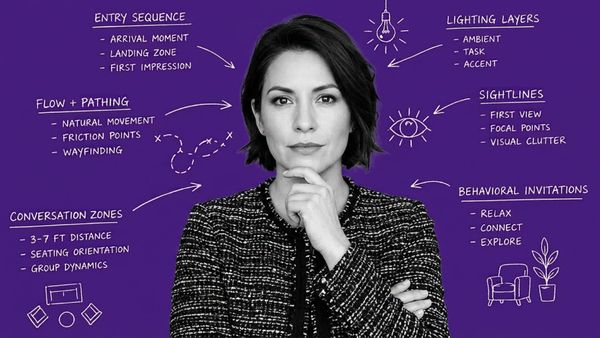
Disney did not design decoration. They designed behavior. The same principles, sightlines, transitions, and visual anchors; can turn a short-term rental into a more intuitive guest experience.

There is an organization that has been practicing Guest Behavior Architecture longer than the discipline had a name. It employs thousands of people specifically to design environments that produce precise emotional and behavioral responses in guests. It has refined that practice across decades and multiple continents. Its results are the most visited, most studied, most financially successful guest experience environments ever built.
That organization is Walt Disney Imagineering.
The principles that GBA applies to short-term rental design are not invented from scratch. They are drawn from a serious and well-documented intellectual tradition of environment-driven behavior design, and Disney's work is the most comprehensive and most instructive example of that tradition operating at scale. Understanding what Disney Imagineering actually does, and why it works, is one of the clearest ways to understand why GBA works, and why the STR hosts who apply its principles will consistently outperform the ones who do not.
What Disney Actually Built
Walt Disney did not set out to build a theme park. He set out to build a place where a specific set of experiences would occur for every guest on every visit, regardless of the time of day, the weather, the crowd levels, or any of the other variables that make hospitality environments difficult to control. He understood from the beginning that achieving that required not just designing attractions but designing the entire environment those attractions existed within.
The result was a practice that Disney would eventually formalize under the name Imagineering: the engineering of imagination. Walt Disney Imagineering is the design and development arm of The Walt Disney Company, responsible for every physical environment the company creates. Its work is not decoration. It is not theming in the sense most people use that word. It is the deliberate, methodical design of physical environments to produce specific guest experiences, emotions, and behaviors. Every queue, every transition, every sightline, every scent, every piece of music, every texture underfoot is a decision made with a behavioral outcome in mind.
This is not a soft claim. Disney parks are among the most empirically studied hospitality environments in existence. The organization's commitment to understanding how guests move through, respond to, and remember its environments has produced a body of knowledge about environmental behavior design that no other hospitality organization comes close to matching. What they learned is the foundation from which Guest Behavior Architecture is built.
The Setting Doctrine
Disney's operational philosophy organizes everything under four quality standards. Among those standards is one they call Show, which refers to the intentional design of the environment as a stage for the guest experience. Every element of a Disney environment is evaluated against whether it is serving the Show, meaning whether it is contributing to the intended experience or detracting from it. A maintenance vehicle visible to guests is a Show failure. A trash can positioned so that guests walk past their own dropped candy wrapper rather than picking it up is a Show success, because the environment was designed to produce that behavioral outcome without requiring any instruction or intervention.
This is what Imagineers call setting. Not scenery. Not decoration. The physical environment understood as an active participant in the guest experience, capable of producing specific behaviors and emotions when designed correctly and working against the intended experience when it is not. Disney's setting doctrine holds that no element of the physical environment is neutral. Every element is either serving the guest experience or undermining it, and the Imagineers' job is to ensure that every element is serving it.
Sound familiar? It should. The First Law of Guest Behavior Architecture, every environment communicates, is the same principle applied to the short-term rental context. What Disney calls setting, GBA calls the communication environment. What Disney evaluates against Show standards, GBA evaluates against behavioral targets. The language is different. The principle is identical.
Guestology: The Science of Knowing the Guest
Disney's approach to guest experience design is built on a discipline they call Guestology, a term developed by the Disney Institute to describe the systematic study of the guest, understanding who they are, what they expect, how they behave, what they feel, and what produces the experiences they remember and return for. Guestology is the recognition that you cannot design an environment for a guest you do not understand, and that understanding the guest requires structured observation and genuine curiosity rather than assumption.
Guestology operates on a foundational insight: guests evaluate their experience against a set of expectations they bring with them, and the gap between those expectations and what they actually encounter determines how they feel about the experience. Guests who receive exactly what they expected are satisfied. Guests whose expectations are exceeded are delighted. Guests whose expectations are not met are disappointed, and the level of disappointment is proportional to the size of the gap.
GBA uses the same framework without the same name. The concept of emotional friction in GBA is precisely the gap between guest expectation and guest reality that Guestology identifies as the primary driver of experience quality. The Behavior Map that opens the GBA process is an exercise in Guestology: defining, with precision, what the guest expects and needs from each zone of the property. The Friction Audit is the evaluation of whether the current environment is meeting those expectations or creating the gap that produces disappointment.
Disney did not invent the relationship between expectation and experience. They studied it more rigorously than anyone else in the hospitality industry and built their entire design practice around managing it. GBA applies the same rigor to the STR context.
Transitions, Sightlines, and the Architecture of Attention
One of the most studied aspects of Disney's design practice is its handling of transitions and sightlines. When a guest moves from one area of a park to another, the transition is never accidental. It is designed to manage the guest's emotional state, to prepare them for what is coming, and to sustain their immersion in the intended experience. The approach to a major attraction is as carefully designed as the attraction itself, because Disney understands that the guest's experience begins not when they arrive at the destination but when the destination first comes into view.
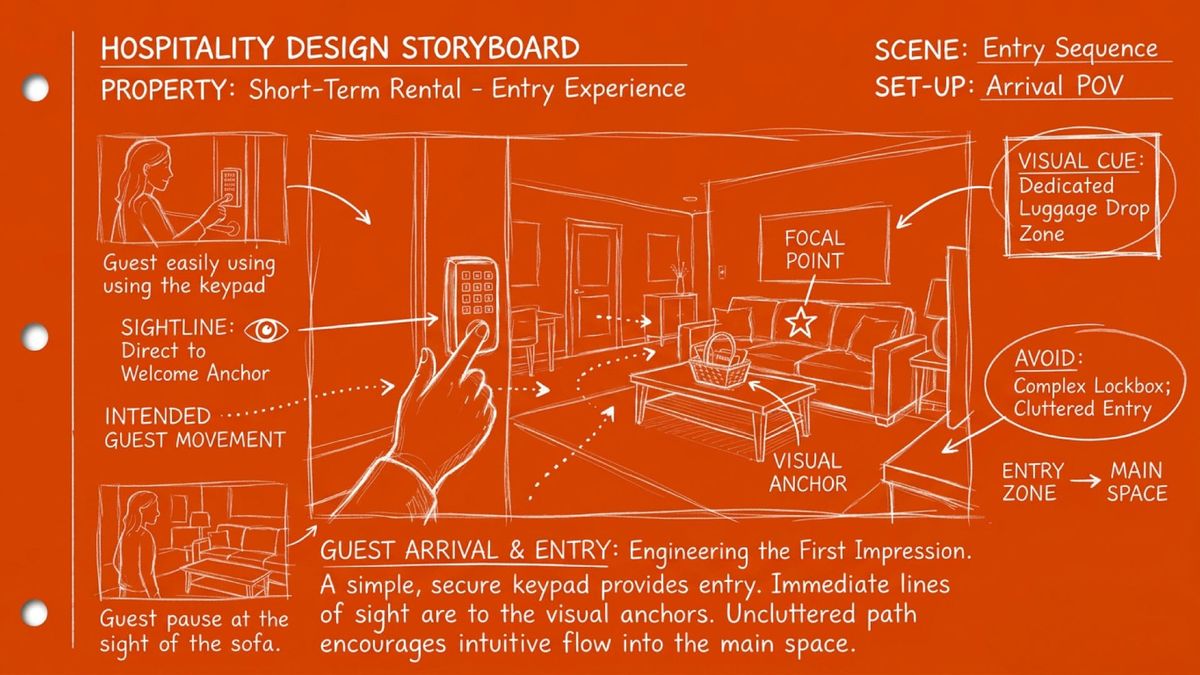
The visual magnet, what Disney designers sometimes call the weenie, is a deliberate design tool: a landmark, an icon, a visual anchor that draws the guest's eye and orients them in the space without requiring a map or a sign. Main Street, U.S.A. ends with Cinderella Castle not by accident but because the castle functions as an orientation device that tells the arriving guest exactly where they are and creates a forward pull that organizes their entire movement through the park. The castle is doing behavioral work before the guest has made a conscious decision.
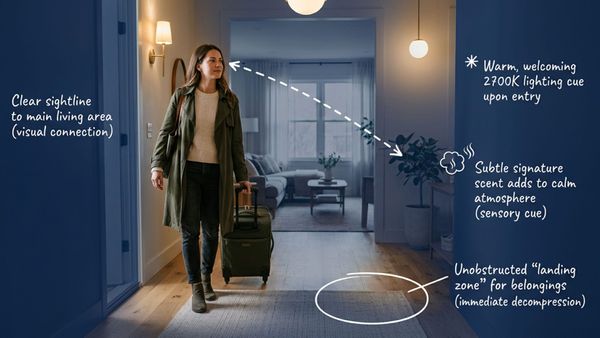
The GBA concept of the Arrival Zone draws directly from this understanding. The first visual anchor a guest receives when they enter a short-term rental is doing the same work as the weenie in a Disney park: orienting them, signaling the character and quality of the experience, and setting the emotional tone for everything that follows. Most STR Arrival Zones have no visual anchor by design. Whatever the guest's eye lands on first is a matter of chance rather than intention. Disney would recognize this as a significant Show failure.
Sightline management in Disney parks ensures that the guest's eye encounters curated views rather than operational reality at every point in the experience. The loading dock is not visible from the dining area. The transition from one land to another is managed with landscaping and sound barriers so that the guest's experience of each land is complete rather than contaminated by adjacency. The principle is that the environment should control what the guest sees, and therefore what the guest thinks about, at every moment.
In STR design, sightline management is the difference between a guest who looks out from the gathering space and sees the property's best feature and a guest who looks out and sees the parking area or the neighbor's fence. It is the difference between a bedroom that feels like a private retreat and one that has an unmanaged sightline to storage that reminds the guest they are in someone else's property. These are not small aesthetic considerations. They are behavioral ones.
Plussing: The Commitment to Going Further
Walt Disney had a word for the practice of taking something that was already good and making it better when no one was watching and no one had asked. He called it plussing. A musician playing in the park who made eye contact with a child and played a request. A landscaper who rearranged flowers to create a better view from a particular bench. A character performer who noticed a guest was hesitant and made a gesture that turned hesitation into delight. Plussing was not a program or a policy. It was a standard embedded in the culture of the organization: the experience can always be better, and the person closest to the guest at any given moment has the authority and the responsibility to make it so.
For the STR host, plussing is the practice of evaluating the guest experience not against a standard of adequacy but against a standard of what is possible. The towel that is folded instead of stacked. The note that addresses the guest by name and references the reason for their stay. The outdoor space that has one more element of consideration than the guest expected. The kitchen that has exactly the tool they needed and did not expect to find. None of these are required. All of them are remembered. And they are remembered because they were experienced as evidence that someone thought about this particular guest, not just about guests in general.
GBA's Design Prescription includes this category of plus: the things that are not friction removal but experience elevation. The recommendations that take a property from performing correctly to performing memorably. Disney has practiced this for decades across properties that cost billions to build. The principle scales to a two-bedroom beach rental in the same way it scales to any environment where a guest is meant to feel that someone genuinely cared about their experience.
The Scale Difference That Does Not Matter
The most common objection to drawing lessons from Disney for STR hosts is scale. Disney employs tens of thousands of people and spends billions of dollars on its environments. The average STR host has one property and a renovation budget measured in thousands. The gap seems too large to cross.
It is not, because the principles are not scale-dependent. The principle that every environment communicates applies to a studio apartment the same way it applies to a theme park. The principle that guest expectations must be understood before an environment can be designed to meet them applies to a one-bedroom cabin the same way it applies to a resort. The principle that transitions between spaces should be managed, that visual anchors should orient guests, that sensory details should be intentional rather than accidental, that friction should be found and removed before the guest encounters it — these are principles of behavioral environment design. They are not principles of big-budget hospitality.
What Disney demonstrates, at the scale Disney operates at, is what these principles produce when they are applied with discipline and consistency. The STR host applying GBA is not trying to be Disney. They are applying the same principles to a different scale of environment with the same underlying intent: to design a space where specific guest experiences occur by design rather than by accident.
Nothing about the guest experience happens by accident. That is the Staygineer principle. It is also, stated differently, the principle that Walt Disney built an empire on.
The intellectual tradition is serious. The application is practical. And the distance between the two is exactly the width of a well-applied methodology.