The Friction Map: The Tool That Changes How You See Your Property Forever
Most short-term rental hosts have an abundance of information about how their property looks and a significant deficit of information about how it performs. What they almost never have is a complete, structured record of how their property actually performs at the moment of guest use.


Most short-term rental hosts have an abundance of information about how their property looks and a significant deficit of information about how it performs. They have professional photographs documenting every angle of every room. They have listing descriptions carefully worded to communicate the character of the space. They have platform dashboards showing booking rates, occupancy percentages, and average nightly revenue. They have reviews, dozens or hundreds of them, filed away and mostly read once.
What they almost never have is a complete, structured record of how their property actually performs at the moment of guest use. What it produces in each zone. Where it creates resistance. Where the gap exists between what the host designed and what the guest experiences. Where the four-star reviews are coming from and what, specifically, is preventing the five-star ones.
The Friction Map is the tool that creates that record.
It is the signature diagnostic output of Guest Behavior Architecture, the document that makes the invisible visible, and the foundation for every design decision that follows. Once a host has a Friction Map of their property, they cannot unsee what it shows them. The property will never look the same again.
Every Property Needs a Diagnosis Before It Needs a Prescription
The instinct most hosts have when they want to improve their property is to start making changes. New furniture. Better photography. Updated amenities. A fresh coat of paint in the bedroom that has always felt slightly off. These decisions are made on intuition, on what the host noticed during a walkthrough, on what a guest mentioned in a review, or on what a competitor appears to be doing that seems to be working.
All of those inputs are incomplete. Intuition is filtered through familiarity and misses what familiarity has made invisible. Guest reviews, as established in this series, almost never identify friction directly. Competitor observation tells a host what is visible in photography and nothing about what is actually performing in the guest experience. And the review that mentioned something once may be the surface expression of a friction pattern that has been present in every stay for two years.
Making design changes without a diagnosis is the equivalent of treating symptoms without understanding the condition. Some of the changes will help. Many will be neutral. Some will address the visible manifestation of a friction point while leaving the underlying cause untouched. And without a diagnostic baseline, there is no way to know which outcome any given change produced, because there is no before state documented with enough precision to measure against.
The Friction Map provides that baseline. It is the diagnosis. Everything that follows it, the repositioned furniture, the reorganized kitchen, the improved light control, the redesigned arrival experience, is the prescription. And the prescription is only as good as the diagnosis it comes from.
What the Friction Map Is
The Friction Map is a structured, zone-by-zone documentation of every friction point present in a property at the time of the audit, paired with a design prescription for each one. It is not a punch list. It is not an inspection report. It is not a list of things that are broken or wrong in a conventional sense. It is a comprehensive record of every point where the property's current design is producing an outcome other than the one the guest experience requires.
That distinction matters. Many of the friction points a Friction Map identifies are not problems in the obvious sense. The furniture is not broken. The kitchen is not dirty. The bedroom is not uncomfortable. The friction is subtler than that. It is the furniture that is positioned correctly for the photograph and incorrectly for the conversation the Gathering Zone is supposed to enable. It is the kitchen that is fully equipped and organized in a way that a host who knows the space can navigate fluently and a first-time guest finds disorienting. It is the bedroom that has everything the guest needs to sleep and not quite enough of what the guest needs to sleep well.
The Friction Map names all of it. With zone. With friction type. With a description specific enough to act on. And with a design prescription that translates each finding into a concrete, buildable change.
The Map is a living document in the sense that it reflects the state of the property at a specific moment in time. As prescriptions are implemented and conditions change, the Map is updated. Over time, it becomes a record of the property's evolution as a guest experience, not just as a physical space.
What the Friction Map Captures
The Friction Map is organized around the four behavior zones, and within each zone it evaluates against the four friction types. That structure is not arbitrary. It ensures that no area of the property and no category of friction is evaluated in isolation from its purpose.
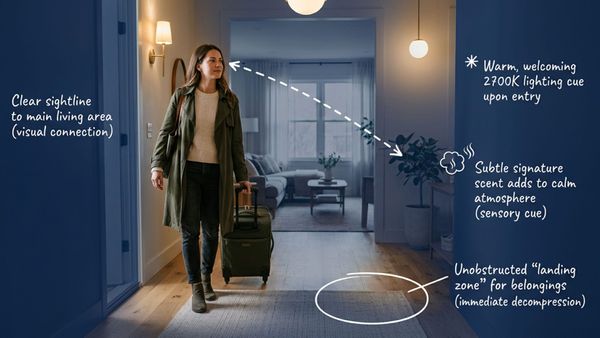
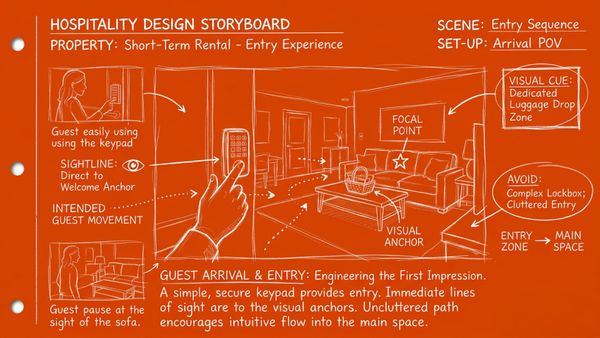
In the Arrival Zone, the Map captures everything that affects whether a guest can transition from the journey to the stay with clarity and ease. The approach to the property. The entry mechanism. The first interior experience. The visual orientation. The handling of luggage and immediate belongings. The first communication the property makes to the arriving guest and whether that communication matches what the stay promises. Every point of resistance in that sequence is documented, named by type, and prescribed against.
In the Gathering Zone, the Map captures everything that affects the social experience of the stay. Furniture arrangement relative to actual group behavior rather than visual balance. Kitchen layout relative to the cooking behaviors the space is intended to support. The indoor-outdoor connection and whether it makes the transition between those environments easy or effortful. The visual and sensory character of the space and whether it communicates permission and ease or caution and restraint. Surface availability and whether it supports the living behaviors a gathered group actually engages in.
In the Restoration Zone, the Map captures everything that affects the quality of rest and private recovery the stay is supposed to provide. Light control and its adequacy for the sleep behaviors the bedroom needs to support. Sound management and whether the acoustic environment of the room is consistent with genuine rest. Bedding quality and its alignment with the climate and the price point of the property. Spatial organization of the bedroom and bathroom and whether a guest who has never been there before can move through those spaces in the dark without friction. Sensory character and whether the restoration environment communicates peace or residual occupation by someone other than the current guest.
In the Experience Zone, the Map captures everything that affects whether the property's distinguishing features are actually delivered to the guest at the quality the listing implied. Discovery friction and whether the feature is visible and communicated or hidden and assumed. Accessibility friction and whether using the feature requires knowledge or effort the guest should not have to supply. Quality friction and whether the feature in use corresponds to the feature in the listing photography. Instructional clarity and whether the guest knows without asking how to use, enjoy, and care for the property's signature experience.
Across all four zones, the Map also captures cross-zone friction, the points where a friction in one zone produces downstream effects in another. An Arrival Zone that fails to orient the guest creates informational friction that carries into the Gathering Zone before anyone has unpacked. A Gathering Zone that communicates restraint rather than permission suppresses the Experience Zone behaviors that motivated the booking. A Restoration Zone that underdelivers on rest produces a guest who is slightly depleted throughout the stay and less capable of fully engaging with the Experience Zone. The Friction Map makes these connections visible because it documents the property as a system, not as a collection of independent rooms.
What the Output Looks Like
A completed Friction Map is a detailed, navigable document organized by zone and friction type. Each entry contains four components, and the specificity of each component is what makes the Map actionable rather than merely informative.
The location names exactly where in the property the friction point was identified. Not the bedroom, but the primary bedroom, east-facing window, morning light management. Not the kitchen, but the kitchen counter, left of the stove, prep surface availability. The precision of the location is what allows the prescription to be specific enough to implement.
The friction type identifies which of the four categories the friction point belongs to: physical, sensory, informational, or emotional. The type determines the nature of the intervention required. Physical friction is addressed through repositioning, reorganization, or replacement. Sensory friction is addressed through adjustments to light, scent, sound, or temperature. Informational friction is addressed through improved communication at the point of need. Emotional friction is addressed through alignment between what the listing implies and what the space delivers.
The description explains what the friction point is producing in a guest at the moment of encounter. Not just what is wrong, but what experience the friction creates. The guest who arrives at the primary bedroom window at six in the morning encounters light that is not controlled adequately for sleep, wakes before they intended to, and begins the day slightly depleted. That description connects the friction point to its behavioral consequence, which is what justifies the prescription that follows.
The design prescription names the specific, actionable change that addresses the friction point. Install blackout lining on the existing curtains. Reposition the cutting board storage to the cabinet directly below the prep surface. Add a single-page visual guide to the outdoor kitchen posted at point of first contact. Move the accent chairs from their current position to the configuration that allows four people to face each other without the coffee table functioning as a barrier. The prescription is not a direction to make improvements generally. It is an instruction specific enough to execute without further interpretation.
How the Friction Map Changes What the Host Sees
The most significant effect of the Friction Map is not the changes it enables. It is the change in perception it produces in the host who receives it. Once a host has seen their property documented at the level of precision a Friction Map requires, they cannot return to seeing it through the photographic lens that most STR design conversation operates in.
They start walking through the space differently. They notice the moment a guest would encounter uncertainty and ask what is producing it. They look at the kitchen and ask what a first-time user would do first, and whether the space is organized to make that first move easy. They look at the living room and ask whether a group of four people who wanted to have a conversation would actually choose to sit where the furniture is placed. They look at the bedroom and think about six in the morning rather than the listing photo.
That shift in perception is the durable value of the Friction Map. The specific prescriptions it generates are implementable and valuable. But the change in how the host sees their property is what prevents the next generation of friction from going unaddressed. A host who has been through the Friction Map process is a host who has internalized a different standard for evaluating their property. Not how it looks. How it performs.
Why This Tool Did Not Exist Before
The short-term rental industry has produced an enormous number of guides, frameworks, checklists, and staging philosophies. Most of them operate at the level of visual appeal, functional adequacy, and competitive positioning. Very few of them ask what the property is producing in the guest at the moment of actual use, and none of them have provided a structured, zone-by-zone, friction-typed methodology for documenting the answer with enough precision to act on it.
The Friction Map exists because the question it answers has not been adequately asked. The industry has optimized for the booking and assumed the stay would follow. Guest Behavior Architecture is built on the recognition that the stay requires its own methodology, its own diagnostic tools, and its own design standard. The Friction Map is the primary diagnostic tool of that methodology.
A host with a Friction Map of their property has something no listing platform, no photography investment, and no competitor analysis can provide: a complete, honest, specific account of how their property performs when a guest is actually living in it, and a clear prescription for closing the gap between current performance and what the property is capable of.
That is intelligence the property has always contained. The Friction Map is simply the tool that makes it readable.