The Four Behavior Zones Every STR Property Has (Whether the Host Designed Them or Not)
Walk into any short-term rental in the world and the same four behavioral territories exist. It does not matter if the property is a studio apartment above a garage, a six-bedroom beach house, or a one-room cabin with a loft. The zones are there.

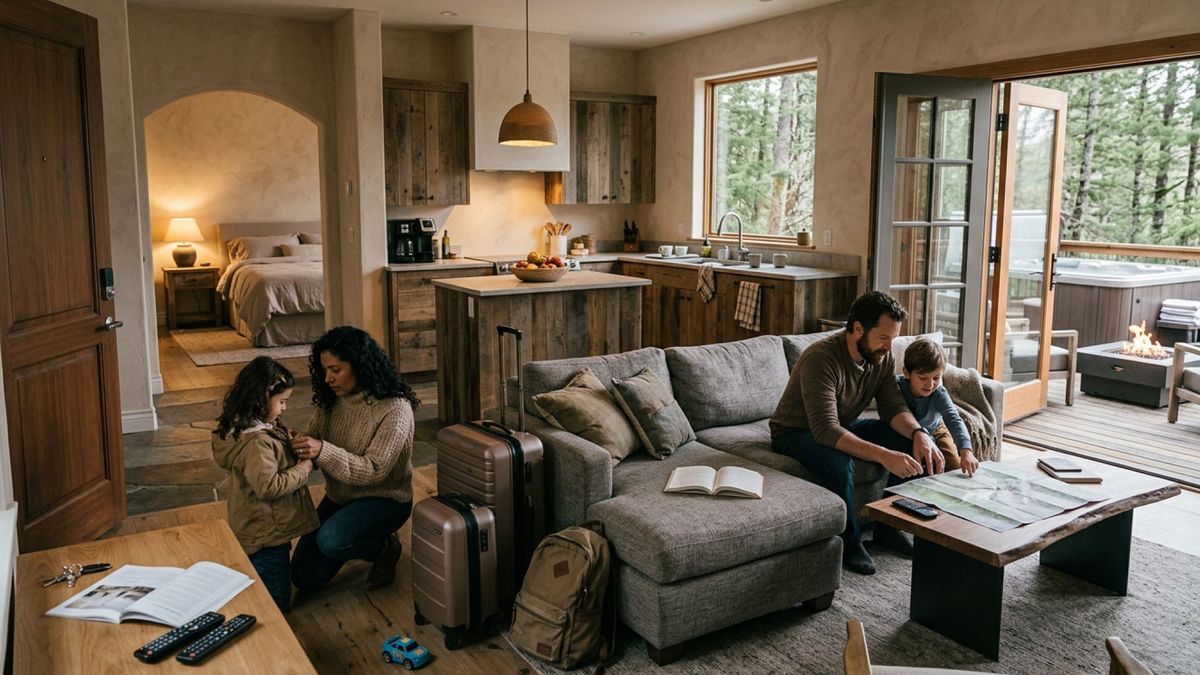
Walk into any short-term rental in the world and the same four behavioral territories exist. It does not matter if the property is a studio apartment above a garage, a six-bedroom beach house, or a one-room cabin with a loft. The zones are there. The guest will move through them, use them, and form their experience inside them whether anyone planned for that or not.
That is the thing most hosts have never been told: the four behavior zones are not a design choice. They are a guest reality. They exist because of how people behave when they occupy a space, not because of how architects or designers or hosts organized the rooms. The question is never whether the zones exist. The question is whether the host has designed for what those zones need to produce.
Guest Behavior Architecture names the four zones, defines what each one is responsible for, and provides the framework for evaluating whether a property is serving them or ignoring them. The names are straightforward because the concepts are: the Arrival Zone, the Gathering Zone, the Restoration Zone, and the Experience Zone.
Understanding what each zone is designed to produce is the mental model that changes how a host sees every room in their property.
Every Property Has These Zones
Before defining each zone, it is worth being precise about what a zone is and is not. A zone in the GBA framework is not a room. It is a behavioral territory. A single room can contain more than one zone, and a single zone can span more than one room. What defines the zone is not the architecture. It is the behavioral purpose the space is serving at any given moment in a guest's stay.
A kitchen and a living room that open to each other might share the Gathering Zone. A bedroom that also has a reading chair by the window might contain both the Restoration Zone and a quiet corner of the Experience Zone. A covered porch that is only accessible through the primary living space might serve as both the tail end of the Arrival Zone and the entry point to the Experience Zone.
This distinction matters because it prevents the mental trap of treating zone design as room-by-room decoration. The zone framework asks the host to think about what the guest is trying to do at each stage of their stay, and then evaluate whether the physical environment is set up to support that. It is a behavioral map layered over a physical map, and the two are not always the same.
The Arrival Zone
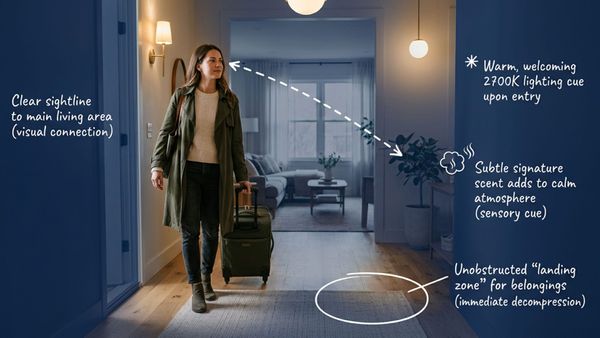
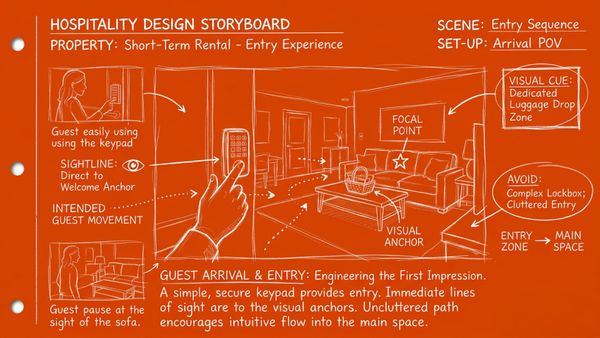
The Arrival Zone is the first conversation the property has with the guest, and it happens in a compressed window of time. From the moment the guest pulls into the driveway or approaches the front door to the moment they have oriented themselves inside the space, the Arrival Zone is setting the emotional tone for the entire stay.
The behavioral job of the Arrival Zone is transition. The guest is arriving from somewhere else, which means they are carrying the stress, fatigue, and logistical residue of getting there. They have been driving or flying or navigating. They have been managing children or luggage or travel complications. The Arrival Zone has to absorb all of that and replace it with a clear, settled sense of having arrived somewhere good.
What produces that transition is not decoration. It is clarity and ease. A well-designed Arrival Zone tells the guest exactly where to go, exactly where to put what they are carrying, and exactly what the space is going to be. It answers questions before the guest has to ask them. It removes the cognitive load of orientation and replaces it with the physical and emotional experience of landing.
Arrival Zone failures are disproportionately expensive because of when they happen. A guest who arrives and immediately feels confused, unwelcome, or uncertain carries that feeling into every subsequent experience in the property. The damage compounds before the stay has formally begun. Conversely, an Arrival Zone that delivers a strong first experience creates positive momentum that carries through the entire stay and is genuinely difficult to reverse. The Arrival Zone is not the most glamorous design challenge in a short-term rental. It is the most important one.
Common Arrival Zone friction points include entries with no clear place to set bags, lock mechanisms that are difficult to operate on a first try, properties with no visual anchor that orients the guest to the layout, transitions from outside to inside that feel abrupt or unwelcoming, and a complete absence of anything that acknowledges the guest has arrived. Each of these is solvable. None of them requires a renovation. All of them matter more than most hosts realize.
The Gathering Zone
The Gathering Zone is where the social experience of the stay happens. It is the territory of connection, shared meals, group conversations, collective downtime, and the collaborative experience of being somewhere together. For most properties, the Gathering Zone is primarily the main living area and kitchen, but it extends wherever the group naturally comes together — an outdoor dining area, a fire pit, a game room, a covered porch.
The behavioral job of the Gathering Zone is permission. Guests need to feel that the space is genuinely theirs for the duration of the stay, that they can use it the way they want to use it, that it was set up for people rather than for photographs. A Gathering Zone that communicates permission produces connection. One that communicates caution produces restraint, and restraint is the enemy of the shared experience that motivated the booking in the first place.
Permission is communicated through furniture arrangement, surface availability, kitchen accessibility, and the overall visual language of the space. A couch that wraps around and creates an enclosure says everyone sit down and stay awhile. A set of chairs arranged around a coffee table that has nothing on it a guest could actually use says this room is for sitting, not for living. A kitchen where the counters are clear and the tools are findable and the layout makes sense says cook here. A kitchen where every surface is occupied by something decorative says this is not really for you.
The Gathering Zone is also where the social architecture of the property reveals itself. Whether the living area and kitchen communicate with each other, whether the indoor and outdoor spaces feel connected or separate, whether there is a natural focal point that organizes where people want to be — these structural questions determine whether a group can actually gather the way they hoped to, or whether the space quietly works against it.
Gathering Zone failures tend to produce reviews that reference a property being nice but never quite feeling like home, or a trip where the group did not spend as much time together as they expected. The host reads those and cannot identify the cause. The cause is almost always in the design of the space that was supposed to make gathering easy and did not.
The Restoration Zone
The Restoration Zone is the private retreat within the property. Bedrooms, bathrooms, quiet reading spaces, any area of the property where a guest is meant to decompress, sleep, and recover. The behavioral job of the Restoration Zone is, by name, restoration. The guest needs to leave this space in better condition than they entered it.
That sounds simple. It is one of the most commonly underserved zones in short-term rental design, because the host's attention naturally goes to the spaces that photograph well and the spaces guests describe explicitly in reviews. Bedrooms photograph well enough. Guests rarely describe them in specific terms unless something went wrong. The result is that Restoration Zones often receive the minimum investment required to avoid complaint, when they should be receiving the investment required to produce the behavioral outcome that justifies the whole trip.
Guests do not book short-term rentals primarily because of the living room. They book because they need to be somewhere that is not their normal life. They need to sleep well, to have privacy, to have space that is genuinely theirs. The Restoration Zone is where that need either gets met or it does not, and the quality of that meeting determines whether the guest wakes up each morning feeling like the trip was worth it.
Restoration Zone design asks specific questions. Is light control sufficient for the way people actually sleep? Is the bedding quality appropriate to the climate and the price point of the property? Is there a place to put personal items that does not require moving something else first? Is the bathroom organized in a way that feels like a guest amenity rather than a utility room? Is sound managed well enough that rest is genuinely possible? These are not luxury questions. They are behavioral questions, and the answers determine whether the Restoration Zone does its job.
A Restoration Zone that works produces a guest who wakes up on day two of a seven-day stay already feeling that the trip was the right decision. A Restoration Zone that underdelivers produces a guest who is slightly off for the entire stay without knowing why, and who leaves having spent seven days in a property that never fully felt restorative.
The Experience Zone
The Experience Zone is the property-specific territory that differentiates this stay from any other stay the guest could have booked. It is the hot tub, the private pool, the rooftop deck, the fire pit, the game room, the proximity to the trail, the view from the primary bedroom window, the kayaks in the garage, the outdoor kitchen, the hammock between the two live oaks. It is whatever this property offers that is specific to this property.
The behavioral job of the Experience Zone is delivery. The guest booked this property because of something it had. The Experience Zone has to actually deliver that something, which means it has to be accessible, usable, and as good or better than the listing implied. An Experience Zone that requires the guest to work to access it, to figure out how to use it, or to discover it at all has already failed its primary purpose.
Discovery failure is more common than it should be. A property with a spectacular outdoor space that is not visible from the main living area, or not mentioned in the arrival information, or not set up in a way that communicates this is for you, is a property where guests may spend three days inside before realizing they had something remarkable outside. That is an Experience Zone failure, and it is entirely the result of design rather than the quality of the experience itself.
Accessibility failure happens when the Experience Zone requires effort or knowledge the guest does not naturally have. A hot tub with a complicated startup sequence and no instructions posted nearby. Kayaks in a garage with no indication they are available for guest use. An outdoor kitchen that is fully equipped but never communicated as part of the stay. In each case, the property has something valuable that the guest did not receive full value from, not because the feature was inadequate, but because the design failed to deliver it.
The Experience Zone is also the zone most responsible for the reviews that drive future bookings. The guest who fully uses and enjoys the distinguishing feature of a property is the guest who writes about it in specific, enthusiastic terms. That review is the one that sells the property to the next guest better than any listing photograph. Getting the Experience Zone right is not just about the current guest. It is about the compounding effect of enthusiastic reviews on the property's long-term booking performance.
The Zone Framework in Practice
The four-zone framework is a mental model before it is a design tool. The first thing it gives a host is a new way of seeing their property, not as a collection of rooms to furnish and photograph, but as a system of behavioral territories each with a specific job to do.
That shift in perspective changes the questions a host asks. Instead of asking whether the living room looks good, the host asks whether the Gathering Zone communicates permission and produces the conditions for connection. Instead of asking whether the bedroom is comfortable, the host asks whether the Restoration Zone produces the quality of rest the guest needs to feel the stay was worth it. Instead of asking whether the hot tub looks clean in photos, the host asks whether the Experience Zone is set up to actually deliver what it promised.
Different properties have these zones in different configurations. A studio apartment compresses all four zones into a small footprint, which makes the design challenge more concentrated but not fundamentally different. A large multi-bedroom house spreads them across a complex layout, which introduces navigation and discovery challenges the studio does not have. The zones are always there. The design challenge is always the same: what does each zone need to produce, and is the current configuration producing it.
The posts ahead in this series will go deep into each zone individually, covering the specific design decisions, the most common friction points, and the particular behavioral outcomes each zone needs to deliver. The zone framework is the map. Everything that follows is the territory.