Stop Designing for the Photo. Start Designing for the Behavior.
The short-term rental industry has a design problem. It is not a problem of taste or budget or effort. It is a problem of metric.

The short-term rental industry has a design problem. It is not a problem of taste or budget or effort. It is a problem of metric. The industry measures design success by how a space photographs, and it has been doing that for so long that most hosts have stopped questioning whether that is the right measure at all.
It is not.
A photograph captures light, composition, and the impression of a moment. It does not capture what it feels like to wake up in a room. It does not capture whether the kitchen layout cooperates with how a real family cooks. It does not capture whether the seating arrangement supports a conversation between four people who came somewhere to reconnect. The photograph is a sales tool. It earns the booking. It has almost nothing to do with the stay.
Guest Behavior Architecture makes a distinction that should be obvious but rarely is: the guest does not live in the photograph. They live in the space. And those are two fundamentally different design problems.
The Photo Became the Product
The rise of platform-based short-term rental booking changed what hosts were optimizing for, and it did it quietly. When a guest books on a platform, the first thing they interact with is the listing, and the listing is photographs. The hosts who learned to photograph well got more bookings. The platforms rewarded higher booking rates. The market sent a clear signal: photography matters.
It does matter. No one serious about STR design is arguing otherwise. But somewhere in that feedback loop, a subtle and consequential shift happened. Hosts stopped thinking about the guest staying in the space and started thinking about the guest scrolling through photos of the space. They are not the same guest. They are not making the same evaluation. One is deciding to book. The other is deciding whether to come back.
The host who designs for the booking and the host who designs for the stay are making different decisions at every point. The difference shows up in how they think about a decorative piece on a kitchen counter, a throw pillow arrangement on a bed, the placement of furniture relative to a window, the choice of lighting for a space used at multiple times of day. In every one of those decisions, the photo-optimized choice and the behavior-optimized choice are sometimes the same thing, and sometimes not. When they are not, most STR hosts choose the photo. Guest Behavior Architecture chooses the behavior.
What Photo-Optimized Design Actually Costs
Photo-optimized design costs the most in the places the camera never fully captures: the moments of friction that accumulate across a stay and produce the gap between a four-star review and a five-star one.
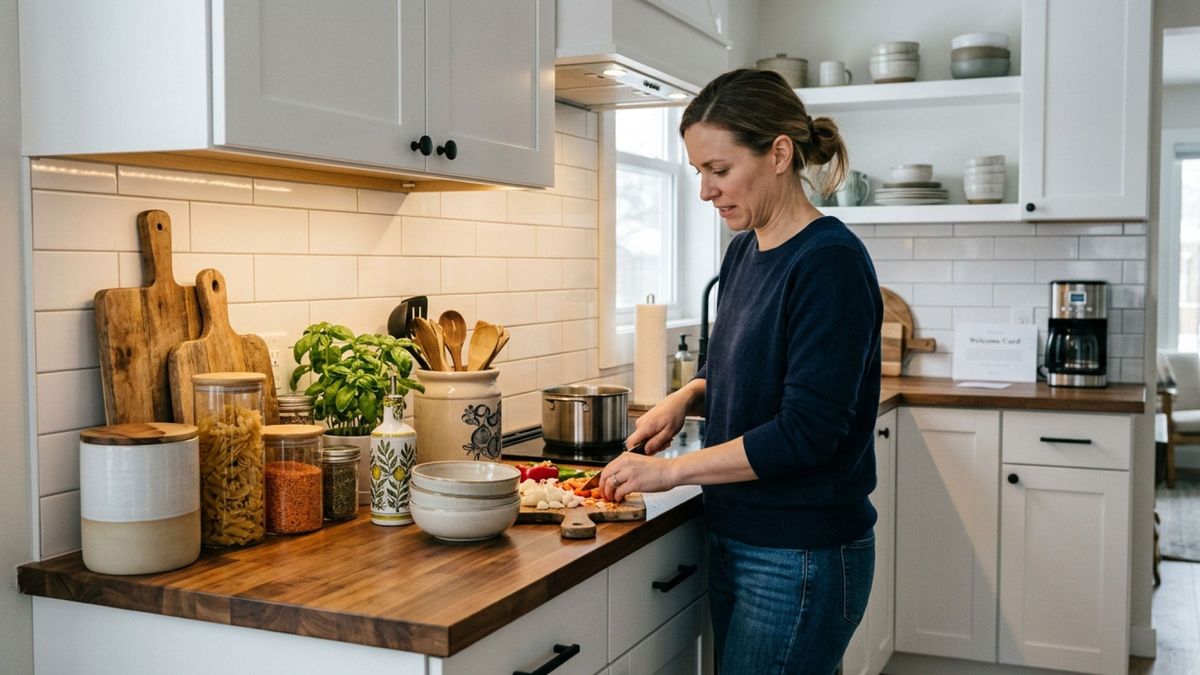
The kitchen styled for photography has clear surfaces and clean lines and a few carefully chosen objects that read as intentional. It photographs beautifully. The guest who tries to cook a real meal in it discovers there is nowhere obvious to put things, the prep surface is smaller than it appeared, and the decorative objects that made the listing compelling are now in the way. They cook something simpler than they planned. They do not mention the kitchen specifically in the review, but they note that it was a fine stay and they might try somewhere else next time.
The bedroom styled for photography has a complex pillow arrangement, a throw folded precisely at the foot of the bed, and decorative items on both nightstands. It reads as elevated and considered. The guest who sleeps there removes everything before bed, stacks it somewhere, and wakes up to a room that no longer looks like the listing. The pillow arrangement is not how they sleep. The throw is on the floor. The experience of the room, which is primarily an experience of sleeping and waking and the quality of those things, was not designed for them. It was designed for the camera.
Neither of these hosts made a careless decision. They made the decision the industry trained them to make. The problem is that the industry trained them to optimize for the wrong moment.
The Behavior Test
Guest Behavior Architecture proposes a different evaluative standard for every design decision. Not how will this look in a photograph, but what behavior will this produce in a real guest using this space?
The behavior test is simple to state and genuinely demanding to apply. It requires the host or designer to think past the visual impression of a decision and into the lived reality of it. It requires imagining a real person, at a real moment in their stay, encountering that design choice, and asking what that encounter produces.
A couch positioned for photographic balance but angled away from where a group will naturally gather fails the behavior test. It looks right. It functions wrong. A couch positioned for how four people actually use a living room together, even if it photographs less symmetrically, passes the behavior test. The guest sits in it. The conversation happens. The gathering zone does its job.
A bed with eight decorative pillows fails the behavior test the moment a tired guest has to remove and store all of them before sleeping. It passed the photo test. It created friction the camera did not capture and the guest will not forget, even if they cannot name it when writing the review.
A kitchen with beautiful pendant lights and an inadequate prep surface fails the behavior test for any guest who planned to cook. The kitchen that works as a kitchen, organized around the behaviors cooking requires, passes the behavior test even if the pendant lights are less remarkable.
The behavior test does not require ugliness. It does not require choosing function over form at every point. It requires that form serve the behavior, rather than replace the consideration of behavior entirely.
What Behavior-First Design Looks Like
The starting point of behavior-first design is not a mood board. It is a question: what do I want guests to do in this space?
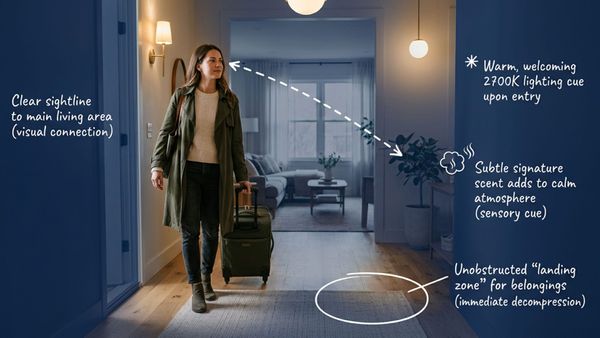
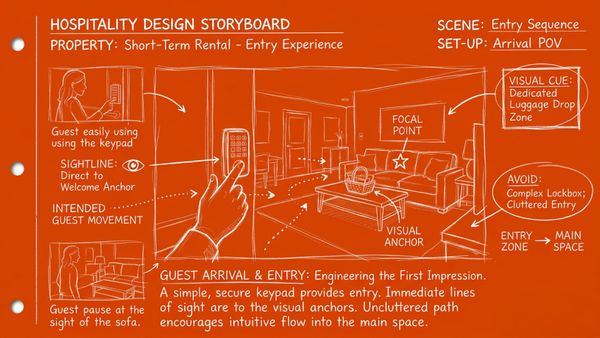
In the Arrival Zone, the behavior the space needs to produce is landing. The guest needs to transition from the road to the stay, from the logistics of getting there to the experience of being there. Behavior-first arrival design asks what physical cues will communicate that this transition is complete. A clear, uncluttered entry. An obvious place for bags and keys. A visual anchor that orients the guest without requiring them to figure anything out. None of those decisions are about how they photograph. All of them are about what they produce.
In the Gathering Zone, the behavior the space needs to produce is connection. Whatever brought this group to this property together, the gathering zone needs to make it easy for that thing to happen. Behavior-first gathering design asks where the group will actually sit, what they will be doing, whether the layout supports that activity, and whether the furniture arrangement communicates invitation. A sectional that wraps around a fire table and creates a natural enclosure for conversation is a behavior-first decision. A set of chairs arranged for visual symmetry that no group would ever naturally sit in together is a photo-first decision.
In the Restoration Zone, the behavior the space needs to produce is rest. Genuine rest. The kind that makes a guest wake up and think the stay was worth it. Behavior-first restoration design asks what the guest encounters from the moment they enter the bedroom to the moment they fall asleep, and from the moment they wake to the moment they leave the room. Light control. Sound management. The quality of the bedding relative to the temperature of the space. The presence or absence of things that require management before sleep is possible. These decisions matter because they produce behavioral outcomes the photograph never captures and the review always reflects.
The Room That Passes the Test
A modest room that produces exactly the right behaviors is a design success. A beautiful room that produces the wrong behaviors is a design failure. That sentence is where Guest Behavior Architecture draws a line that most of the STR industry is not yet standing on the right side of.
This is not an argument against beauty or investment or visual quality. It is an argument about what those things are for. Beauty in a short-term rental is not decorative. It is functional. It communicates to the guest that the space was considered, that someone thought about them before they arrived, that the stay was designed rather than assembled. Beauty that serves those communication goals passes the behavior test. Beauty that serves only the photograph does not.
The hosts who understand this start asking different questions. Not which lamp looks better in photos, but which lamp produces the right light at the right time in this specific space. Not which pillow arrangement photographs as elevated, but how many pillows a guest actually sleeps with and what happens to the rest. Not whether the kitchen reads as stylish, but whether a real person can cook a real meal in it without working around decisions that were made without them in mind.
Those questions are harder than the photo-first version. They require the host to think like a guest rather than a photographer. They require holding two images of the space at once: the way it looks in a listing and the way it feels to live in. For most STR hosts, that second image has never been the one making the decisions.
Where This Changes Everything
The mindset shift from photo-first to behavior-first does not require a renovation. It requires a different question. Every existing design decision in a short-term rental can be re-evaluated through the lens of what behavior it produces, and many of the changes that follow from that re-evaluation are small, specific, and immediately actionable.
That re-evaluation is what the Friction Audit produces. It is the systematic application of the behavior test across every zone of the property, and the Design Prescription that follows it is the roadmap for closing the gap between the space as it currently performs and the space as it is capable of performing.
Staygineering starts with this mindset shift because nothing else works without it. The host who is still designing for the photograph is solving the wrong problem with real money and real effort. They will keep solving it, and the gap between their listing and their reviews will stay exactly where it is.
The host who starts designing for the behavior is solving the right problem for the first time. The photograph still matters. It still earns the booking. But now it serves a space that was built to deliver on what the photograph promised. That is the difference. And it is the only version of STR design that closes the gap for good.