Law 3: Design the Behavior, Not the Photo. The Rule That Changes Everything.
The Second Law establishes that friction is present in every guest experience, waiting to be found before the guest finds it first. Both of those laws are descriptive. They describe what is already true.


The first two Laws of Guest Behavior Architecture describe how the world of short-term rental experience works. The First Law establishes that every environment communicates, always and whether the host planned it or not. The Second Law establishes that friction is present in every guest experience, waiting to be found before the guest finds it first. Both of those laws are descriptive. They describe what is already true.
The Third Law is different. It is a directive.
Design the behavior, not the photo.
Everything upstream of this law — the framework, the zones, the friction types, the audit process — is preparation. The Third Law is the instruction that makes all of it actionable. It is the rule that determines which design decisions get made and on what basis. And it is the rule that separates the host who will consistently produce five-star stays from the host who will consistently produce good-looking properties with four-star results.
Two Design Standards, Two Different Outcomes
Every design decision a short-term rental host makes is evaluated against a standard. The standard is almost always unspoken, but it is always present. And for most hosts in this industry, the standard is photographic. Will this look good in the listing? Will this read as elevated and considered when a guest is scrolling through images on a booking platform at ten in the evening deciding where to spend their money?
That standard is not wrong. It is insufficient.
The photographic standard optimizes for a single moment: the moment of the booking decision. It produces properties that perform at their peak when no one is living in them. The rooms look best before anyone arrives. The beds look best before anyone sleeps in them. The kitchen looks best before anyone cooks in it. The photograph captures the property at its most idealized, most controlled, most friction-free moment, and the guest who books based on that photograph will spend the entire stay measuring the actual space against the idealized one.
When the space was designed for the photograph and not for the living, that measurement will reveal a gap. Not necessarily a dramatic one. Not a gap that produces complaints. A gap that produces the muted, politely positive review that is the ambient sound of a four-star stay: the property looked exactly like the photos. It was very comfortable. We enjoyed our time there.
The behavioral standard optimizes for a different moment: the full duration of the stay. Every moment a guest is present. Every intent they bring to the space and every time the space either supports or resists that intent. Every morning they wake up and every evening they wind down and every meal they try to cook and every conversation they try to have in a space that either makes those things easy or makes them slightly harder than they need to be.
A property designed against the behavioral standard will photograph imperfectly and perform perfectly. The couch is positioned where the group actually wants to sit, not where it looks most symmetrical in a wide-angle shot. The kitchen counter has clear workspace because cooking requires it, not decorative objects because they photograph as considered. The bedroom has genuine light control because sleep requires it, not curtains chosen for their visual softness. The property does not look its best before anyone arrives. It feels its best while they are there.
Photos attract bookings. Behaviors produce reviews. That is the business reality the Third Law is built on.
What the Camera Cannot Measure
The camera is a precise instrument for measuring certain things. Color, composition, light at a specific moment, the visual relationship between objects in a frame. It is useless for measuring the things that determine whether a guest stay is genuinely excellent.
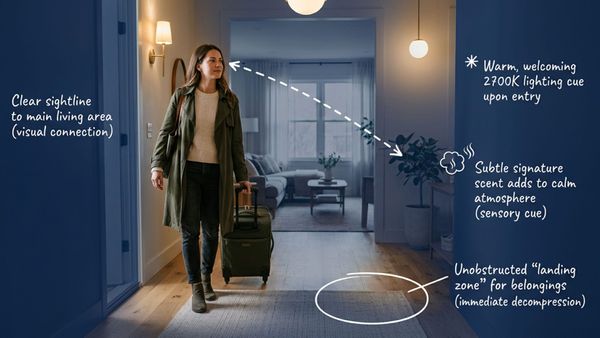
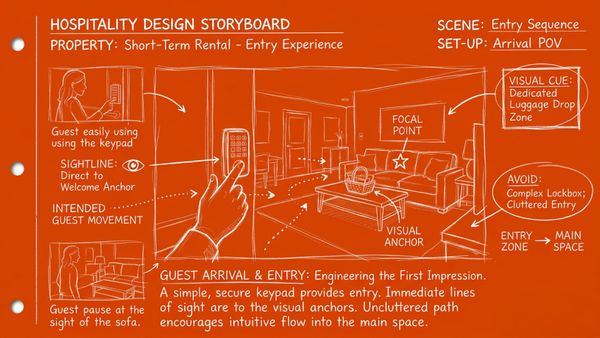
It cannot measure whether the entry communicated welcome or uncertainty. It cannot measure whether the guest slept well or lay awake because the light from the street came through curtains that looked beautiful in the listing and functioned poorly in the dark. It cannot measure whether the group felt permission to fully inhabit the space or a subtle, unexplained sense that the space was not quite set up for them. It cannot measure whether the kitchen cooperated with an ambitious dinner or quietly resisted it until the guest simplified their plans.
These are behavioral measurements. They require a guest living in the space to take them. And they are the only measurements that determine what the review says.
The host who has been designing to the photographic standard has been optimizing for a measurement the guest never takes. The guest does not evaluate the property on how it photographs. They evaluate it on how it performs. Those two evaluations are conducted by different instruments against different criteria, and a property can excel by one measure while failing the other.
This is why the Third Law is a rule that changes everything. It does not add a consideration to the design process. It replaces the primary evaluative standard. Every design decision gets measured against a different question. Not how does this look, but what does this produce.
The Business Case for Behavior-First Design
The argument for the Third Law is not philosophical. It is financial. The behavioral standard produces measurably better business outcomes than the photographic standard, and the mechanism is direct enough to trace clearly.
Reviews are the currency of the short-term rental market. Not follower counts, not listing quality scores, not the attractiveness of the photography. The quality and specificity of guest reviews determine a property's competitive position more than any other single factor. A property with a hundred reviews that use words like exactly what we needed, we will absolutely be back, and the space was set up like someone actually thought about what we would need is a property that commands higher rates, fills its calendar more reliably, and competes at the top of its market regardless of how its photography compares to properties nearby.
A property with a hundred reviews that use words like comfortable, nice, good location, would recommend is a property perpetually competing on price. Its reviews do not differentiate it. Every other property in its market has reviews that say the same thing. The only lever left when the reviews are interchangeable is rate, and competing on rate is a losing strategy in any market where the inventory continues to grow.
The reviews that differentiate a property are almost always behavioral in their specificity. They describe things the guest did, things the space made easy, things they did not expect the space to be capable of delivering. We cooked every single night because the kitchen was so well-equipped and organized. We spent more time on the patio than we have at any rental we have ever stayed in. The beds were the best we have slept in outside our own home. Those sentences are not descriptions of photographs. They are descriptions of behavioral outcomes. They are the evidence that the Third Law was applied.
What Behavior-Designed Properties Look Like in Reviews
There is a pattern to how guests describe a property that was designed against the behavioral standard rather than the photographic one. The pattern is not difficult to identify once you know what to look for.
The reviews are specific. Not specific about the property's appearance, though that sometimes appears too. Specific about what the guest did and how the space responded. The fire pit was the perfect gathering spot every evening. The kitchen had everything we needed exactly where we would have put it ourselves. Waking up in that bedroom was the most rested I have felt in years. These sentences describe moments of behavioral success. The space produced the right behavior at the right moment, and the guest remembered it clearly enough to write about it with that level of specificity.
The reviews are emotional. Not in a sentimental sense, but in the sense that they describe how the stay made the guest feel, not just what it looked like. Felt like a home, not a rental. Like someone actually thought about what we would need. Like the space was designed for us. Those phrases are emotional responses to behavioral success. The guest cannot explain exactly what produced the feeling, but the feeling is the direct result of a space that consistently supported their intents rather than resisting them.
The reviews create future bookings. A review that is specific and emotional is a review that a future guest reading it can project themselves into. When a prospective guest reads we cooked every night because the kitchen was so good, they imagine themselves cooking in that kitchen. When they read we spent every evening on the porch because it was set up perfectly for exactly what we wanted to do, they imagine themselves on that porch. The review becomes a preview of a behavioral experience, and behavioral previews sell stays in a way that photographic ones cannot.
Repeat Bookings and the Rate Premium
The two most direct financial consequences of behavior-first design are repeat bookings and rate premiums, and both operate through the same mechanism.
Repeat bookings happen when the stay exceeded the expectation the booking created. This requires the stay to deliver something the photograph could not fully communicate, because if the stay only delivered what the photograph promised, the guest's expectation was fully met but not exceeded. Exceeded expectations require behavioral performance. The space did something the guest did not anticipate the space could do. It was more restorative than they expected. It was more functional than it looked. It was easier to be in, more cooperative with what they needed, more genuinely welcoming than any previous rental they had stayed in. Those experiences produce repeat bookings, and repeat bookings are the most efficient revenue a short-term rental generates because they require no marketing, no photography investment, and no competition for attention on a booking platform.
Rate premiums happen when the reviews a property generates position it above market rather than within it. A property with consistent, specific, emotionally resonant reviews can command a rate that properties with equivalent photography and similar amenities cannot justify. The reviews are the evidence of a quality the market will pay for. And because behavior-first design produces reviews that are differentiated in the specific way described above, it creates rate leverage that photo-first design, however well executed, cannot.
The compounding effect of these two outcomes over a booking calendar is significant. A property that books at higher rates and generates meaningful repeat business without additional marketing investment outperforms a comparable property that competes only on price and relies entirely on new guest acquisition to fill its calendar. The difference is not the photography. It is the design standard that governed every decision about how the space performs when a guest is actually living in it.
The Rule in Practice
Applying the Third Law in practice means introducing a new evaluative question at every point where a design decision is made. The question is not aesthetic. It is behavioral. What will a guest be trying to do in this space, and does this decision make that easier or harder?
For a furniture placement decision: not which arrangement photographs better, but which arrangement produces the behaviors this zone is supposed to enable. For a bedding decision: not which set photographs as most elevated, but which set produces the quality of sleep this zone is responsible for delivering. For a kitchen organization decision: not which configuration looks most intentional in a listing photo, but which configuration a guest who has never been in this kitchen before can navigate without friction on the first morning.
These questions do not produce ugly properties. Properties designed against the behavioral standard are often beautiful. The difference is that the beauty serves the guest rather than serving the camera. And the guest, who is the only one doing the reviewing, knows the difference between a space that was designed for them and a space that was designed for someone who had never met them.
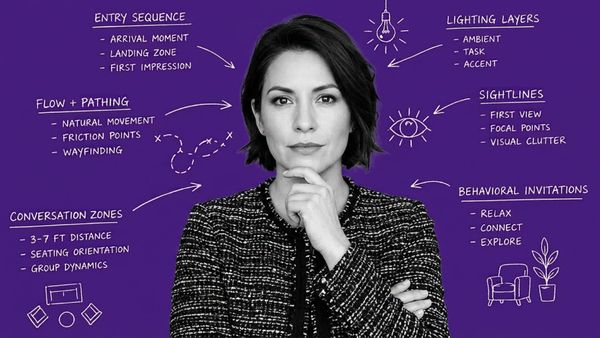
The Three Laws of Guest Behavior Architecture taken together describe a complete and coherent design philosophy. Every environment communicates. Friction is always present and must be found before the guest finds it. And every design decision should be made against a behavioral standard rather than a photographic one. These three laws, applied systematically, produce properties that do not just look like great stays. They are great stays. The reviews say so. The repeat bookings say so. The rate premium says so.
That is the business case. And the business case is the whole case.