Law 1: Every Environment Communicates. What Is Yours Saying?
Guest Behavior Architecture is built on three laws. They are not guidelines or best practices or suggestions for hosts who want to take their property to the next level. They are statements about how physical environments work.


Guest Behavior Architecture is built on three laws. They are not guidelines or best practices or suggestions for hosts who want to take their property to the next level. They are statements about how physical environments work. They were true before GBA named them, and they will be true regardless of whether any particular host accepts them.
The First Law is this: every environment communicates.
Not sometimes. Not in well-designed spaces. Not only when the host intended it. Every environment, in every condition, at every moment a guest is present, is sending signals. Through its light. Through its smell. Through the arrangement of its furniture and what that arrangement implies about what the space is for. Through its visual hierarchy and what it draws the eye toward and away from. Through the way it responds, or fails to respond, to what a guest wants to do inside it.
The environment is always talking. The host's only choice is whether they have decided what it should say.
Why This Is a Law and Not a Theory
The relationship between physical environment and human behavior is one of the most thoroughly documented areas in environmental psychology. Humans read spatial cues constantly and automatically. They do not consciously evaluate a room and then decide how to feel about it. The room communicates and the response happens, largely beneath the level of deliberate thought.
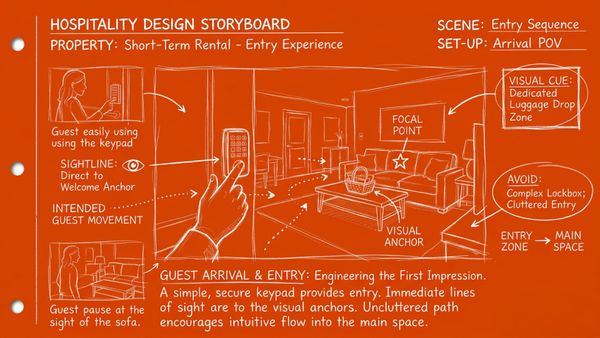
This is why a guest who walks into a dark, cluttered entryway does not think the welcome has not started yet. They feel it. The information arrives as a feeling of being slightly unwelcome, slightly uncertain, slightly less at ease than they were hoping to be. They may not be able to say what caused it. They will carry it regardless.
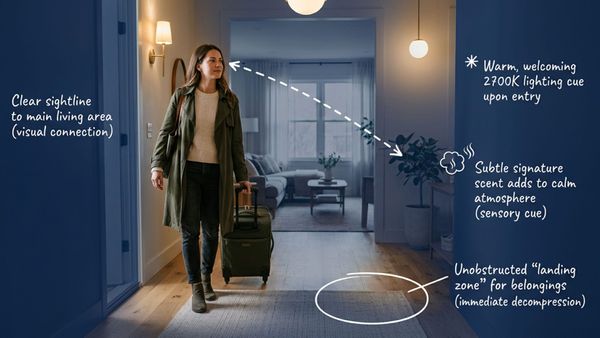
And this is why a guest who walks into an entry that is well-lit, uncluttered, and clearly oriented does not consciously think this property respects my arrival. They feel settled. The transition from the journey to the stay completes more quickly and more completely. The rest of the experience begins from a better starting point.
The environment is communicating in both cases. The signal is just different. And the behavioral outcome is different as a result.
For the short-term rental host, the practical consequence of the First Law is clear: there is no such thing as a neutral property. Every design decision, including the ones that were not made deliberately, is a communication. Every absence, every oversight, every thing that was left in the default position because no one thought carefully about it is sending a signal. The question is not whether the property is communicating. The question is whether the host has listened to what it is saying.
The Five Signal Channels
Environments communicate through multiple simultaneous channels. Guest Behavior Architecture identifies five primary ones, each operating independently and each contributing to the composite signal the guest receives when they occupy a space.
Light is the most immediate channel. It communicates mood, time, purpose, and welcome before the guest has taken a second step. A bright, warm light in an entryway communicates arrival and orientation. A dark entry communicates that the welcome has not been considered. A living room with only overhead lighting communicates a single, flat purpose. A living room with layered lighting at multiple heights communicates that the space has been thought about for actual human use at different times of day. Guests read light before they read anything else, and they read it fast.
Scent is the most emotionally direct channel and the most frequently mishandled. The olfactory system connects to the brain's emotional centers more directly than any other sense, which means scent produces feeling before it produces thought. A property that smells like aggressive cleaning chemicals communicates sanitized, not clean. A property with no scent at all communicates unoccupied. A property with a subtle, appropriate scent that fits the character of the space communicates care. Hosts who do not think about scent are allowing one of the most powerful communication channels in their property to broadcast whatever it happens to be broadcasting, without direction.
Arrangement communicates purpose and permission. The way furniture is positioned tells the guest what the space is for and what they are allowed to do in it. A living room arranged around a single large television communicates that one activity is expected. A living room with a conversation grouping, a reading area, and a clear sightline to the outdoor space communicates that multiple kinds of living are welcome. A kitchen with clear, accessible work surfaces communicates that cooking is supported. A kitchen where every counter is occupied communicates that cooking is tolerated at best. Guests read arrangement and adjust their behavior accordingly, usually before they are conscious of having done so.
Visual hierarchy communicates what matters and what does not. In any space, the eye moves toward certain things and away from others. What the eye moves toward first communicates the priority of the space. A room where the eye goes immediately to a spectacular view communicates that the view is the point of being here. A room where the eye goes immediately to a cluttered bookshelf of the host's personal belongings communicates something quite different. Hosts who have not consciously thought about visual hierarchy have surrendered that communication to chance, and the eye will land on whatever is most visually dominant regardless of whether that is what the host would have chosen.
Responsiveness is the channel that operates across time rather than in a single moment. It is the degree to which the environment responds to what the guest is trying to do across the full duration of the stay. A kitchen that responds well to cooking. A bedroom that responds well to sleep. An outdoor space that responds well to gathering. Responsiveness is not about any single element but about whether the environment, taken as a whole, acts as a cooperative partner in the guest's experience or as a passive and occasionally resistant backdrop to it. Guests feel responsiveness as ease and its absence as friction.
Reading Your Own Property
The practical challenge of the First Law is that most hosts have stopped hearing what their property is saying. The process of becoming familiar with a space is also the process of becoming deaf to its signals. The host who has been in the property dozens of times no longer experiences the scent that greets a first-time guest. They no longer feel the hesitation that comes from an entry without clear direction. They no longer notice that the living room arrangement implies a single activity because they have long since adapted to using the space in ways that work around that implication.
Hearing the property again requires deliberate practice. It requires approaching the space with the explicit intention of receiving it as a guest would receive it, with no pre-existing knowledge of where things are, how things work, or what the space is capable of.
One technique the Friction Audit uses is the arrival walk. The evaluator approaches the property from the street, enters as a first-time guest would enter, and documents every signal received from that point forward without the filter of familiarity. What does the light communicate? What does the scent communicate? Where does the eye go first, and what does that first destination say about what the space is for? Where is the natural first place to set something down, and is that place designed to receive it? What is the first moment of uncertainty, and what produced it?
The answers to those questions are what the property is communicating. They are the signal. And they are frequently very different from what the host intended the signal to be.
When the Signal and the Intent Diverge
The gap between what a host intends their property to communicate and what it actually communicates is one of the most consistent findings of a Friction Audit. Hosts almost universally intend their properties to feel welcoming, comfortable, and considered. The signals many properties actually send are partial, inconsistent, or contradictory versions of those intentions.
A host who intends to communicate warmth but has not addressed lighting communicates an aesthetic version of warmth in the photographs and a cooler, flatter version of it in the actual space. The photograph is warm because the camera captured a moment of good natural light. The space on a cloudy afternoon communicates something different because the lighting design does not hold the warmth without the sun.
A host who intends to communicate that the property is equipped for families but has not thought through kitchen accessibility communicates that the property looks family-ready rather than being family-ready. The pots are there. The pans are there. But if finding a cutting board requires opening four drawers and moving a decorative bowl, the kitchen is communicating obstacle, not support.
A host who intends to communicate a relaxed, retreat-like atmosphere but has left personal belongings, complex operational instructions, and visual clutter throughout the space is communicating something closer to managed vacation than genuine retreat. The guest feels the presence of the host in the space as a low-level constraint on their sense of ownership of the stay.
In each case the host's intent is good. The communication is not matching it. And the gap is invisible to the host precisely because they are reading the space through the lens of their intent rather than through the lens of the signal actually being sent.
What the First Law Requires
Accepting the First Law requires accepting that the host is always the author of the communication their property produces, whether they write it deliberately or not. There is no position of non-authorship available. The host who does not think carefully about what their property communicates is still the author of what it communicates. They have simply written it without paying attention.
What the First Law requires in practice is this: before any design decision is made, or evaluated, or revisited, the host needs to know what signal the current environment is sending. Not what the host intended. What the guest receives. Those two things are not always the same, and closing the gap between them is the first and most foundational work of Staygineering.
The Second and Third Laws of Guest Behavior Architecture build on the First. They take the communication that every environment produces and ask what it should be designed to do and how the host makes sure it does it reliably. But nothing in those laws functions without the First.
If the environment is always talking, and it is, then the host's first job is to listen. To actually hear what the property is saying. To walk through it the way a guest walks through it, to receive the signals without the filter of familiarity, and to confront the gap between the signal and the intent.
That confrontation is the beginning of intentional design. Everything that follows is the work of closing the gap.